Introducing The Bitcoin Market State Methodology
Bitcoin Market State is a structured method for interpreting Bitcoin's market condition by observing the interaction between Bitcoin Supply, Bitcoin Liquidity, and Bitcoin Ownership.
Rather than focusing on short-term price movements, the framework evaluates the structural forces that determine whether the market is coiling, absorbing, expanding, distributing, or declining.
The interaction of these three forces produces what the framework calls Market State.
Price is always an output. Never a driver.
The Market State framework is the foundation of BTCIntelligence and is documented in Reading Bitcoin — A Framework for Interpreting Bitcoin, published March 2026
The Three Variables
Supply
Supply examines the sellable supply of Bitcoin — not total supply, but the portion that can actually reach the market.
It looks at when coins move, when they become dormant, and when long-term holders begin releasing supply back into the market.
Understanding supply reveals whether sell pressure is increasing or whether available Bitcoin is becoming structurally scarce.
Liquidity
Liquidity represents the global financial environment that determines how much capital can flow into risk assets.
Changes in central bank balance sheets, credit conditions, dollar strength, and global monetary cycles all influence the absorption capacity available to Bitcoin.
Liquidity does not determine direction alone. It determines whether the market has the capacity to absorb supply — or cannot.
Ownership
Ownership analyzes who holds Bitcoin and how those holders behave.
Time horizon is power. Long-term holders can wait. Short-term holders cannot. That asymmetry determines who must act and who controls supply.
Tracking shifts in ownership reveals when patient capital is accumulating quietly and when experienced holders are beginning to distribute.
The Five Market States
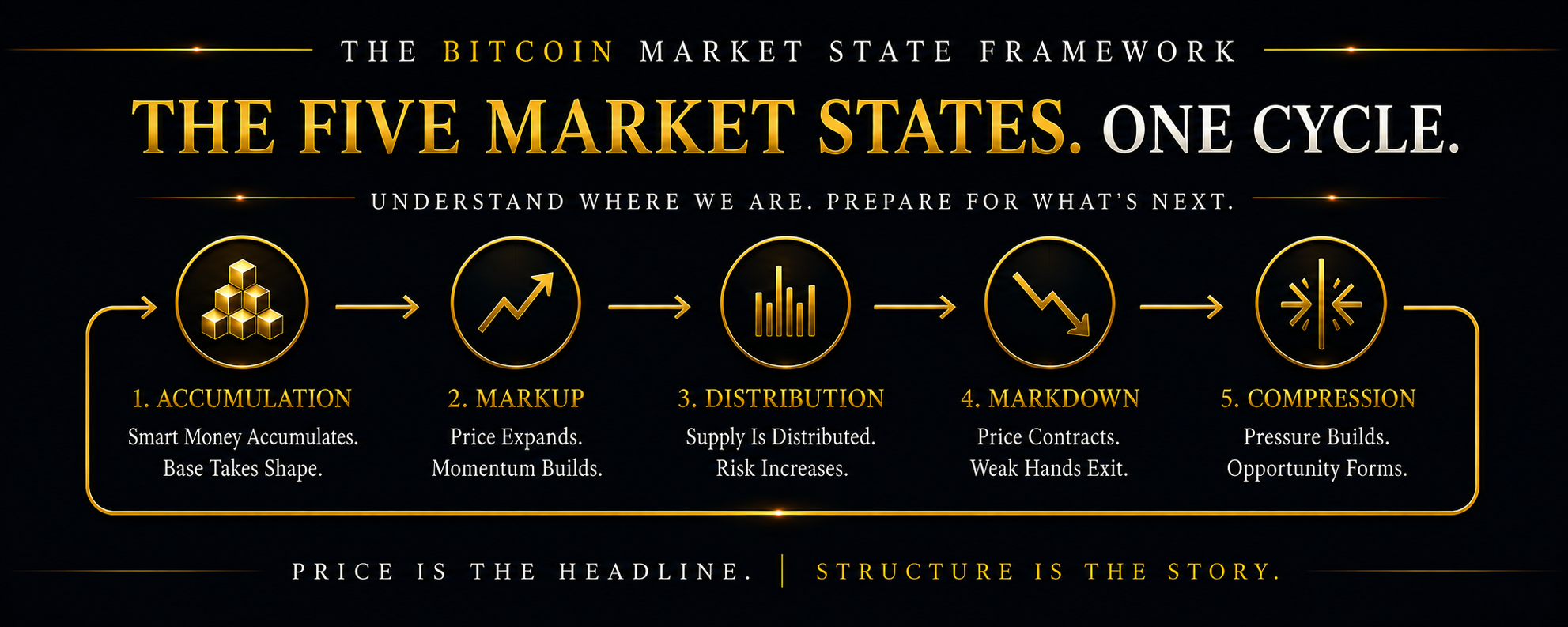
Bitcoin progresses through five recurring Market States. Each state reflects a distinct relationship between Supply, Ownership, and Liquidity, providing a structural framework for interpreting where Bitcoin is today—and which transition condition is most likely to follow.
Rather than reacting to price alone, the Bitcoin Market State methodology identifies the underlying Market State driving price behavior. Understanding the active state provides the context needed to separate structural signal from narrative noise and position with greater clarity and discipline.
01. Accumulation
Patient buyers consistently absorb available Bitcoin.
Ownership strengthens as constrained supply is quietly accumulated. Although price may remain subdued, the market's internal structure continues improving beneath the surface.
Watch for: Liquidity Expanding
02. Markup
Liquidity expands and demand begins overwhelming constrained supply.
Capital deployment accelerates, participation broadens, and the structural foundation built during Accumulation is expressed through sustained price appreciation.
Watch for: Ownership Transferring
03. Distribution
Strong hands gradually transfer Bitcoin into expanding liquidity.
Price may continue advancing, but ownership begins shifting from patient holders to increasingly impatient participants. Structural deterioration often begins before price reflects it.
Watch for: Supply Activating
04. Markdown
Supply overwhelms available demand as liquidity contracts.
Ownership has already weakened, and price begins reflecting the structural deterioration that started during Distribution. Weak hands are forced to sell as selling pressure exceeds available liquidity.
Watch for: Supply Exhausting
05. Compression
Supply is constrained. Ownership is patient. Liquidity remains restrictive.
The market has reached structural equilibrium as selling pressure subsides. Price often moves within a relatively narrow range while the foundation for the next advance is quietly established.
Watch for: Structural Demand Emerging

Understand Bitcoin Beyond Price
The Bitcoin Market State Framework evaluates Supply, Liquidity and Ownership to diagnose Bitcoin’s current structural condition.
Instead of asking where price is going next, it asks:
“Has Bitcoin’s structural condition actually changed?”
The Framework identifies five recurring Market States and tracks transitions between them using confirmation rather than anticipation.
Its purpose is to help investors distinguish temporary price movement from meaningful structural change.
Price is the headline.
Structure is the story.
Click the image to download the free Primer →